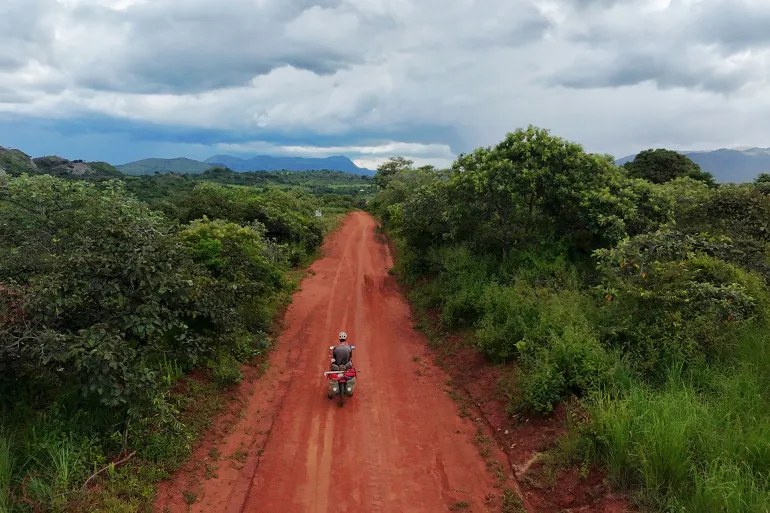
“I don’t classify myself as Moroccan, but rather as African,” with this profound and expressive sentence, Youssef Sahsah (34 years old), a Moroccan from the city of Laayoune, summarizes the essence of his “epic” journey that he undertook on his bicycle across the African continent.
For Sahsah, Africa was not just a continent to visit, but a continuous challenge that shaped his body and touched his soul. After traversing hundreds and thousands of kilometers and facing the most difficult obstacles, his motto along the way became “Africa is not for cowards.” This powerful quote, taken from the tribes of southern Africa, is the principle that illuminated his entire experience.
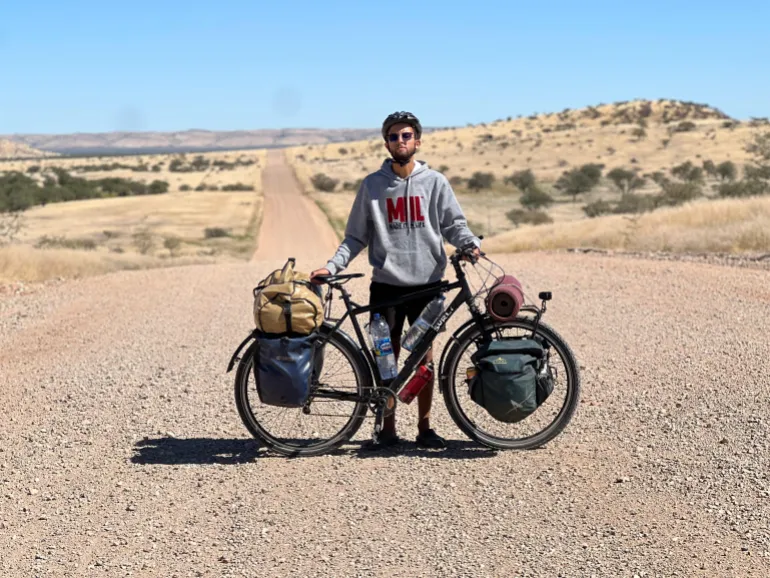
Like many passionate Moroccan travelers, Sahsah chose the bicycle as his passport and decided to explore the continent on his own, shunning conventional travel. He set out in search of knowledge and stories, believing that true life is lived through sharing, even in the most challenging circumstances.
Youssef Sahsah, a graduate of the film institute in Ouarzazate, told Al Jazeera Net, “Travel was not just for entertainment, but a cognitive necessity before it was a continental journey.”
African roots
Sahsah’s journey began with a deeper exploration of his roots, as he ventured into Moroccan cities via hitchhiking, asking questions and learning “like a little child” to melt any ice separating him from the traditions of other Moroccan regions.
After exploring his Moroccan surroundings, he decided to head towards the mother continent, rejecting the usual European attraction among travelers
Sahsah adopts the noble verse “We have made you into nations and tribes so that you may know one another” as a motto for his long journey, and adds, “I think the reason for the problems in the world between peoples is the lack of knowledge of the other… and that is why it was my continent’s turn. The goal was to deepen my knowledge of its traditions and customs, and this is the most important thing for our continent, as there is no progress without knowing each other and accepting the other.
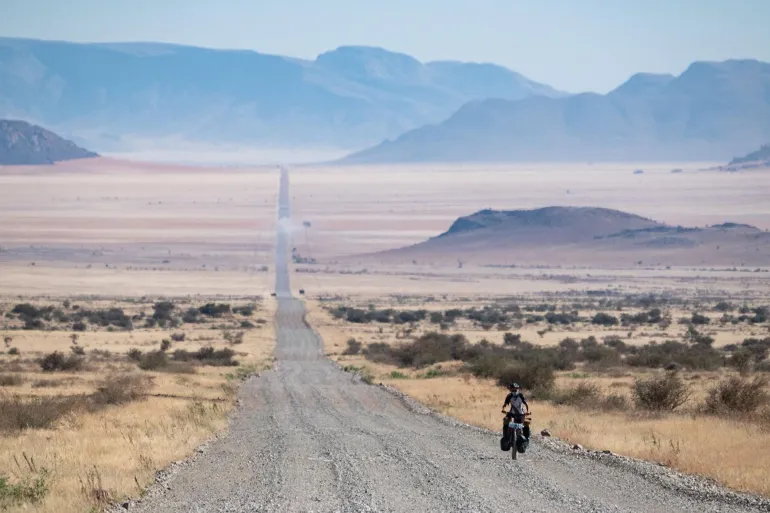
As for Mohamed Saleki (28 years old), he says that he met a number of people, some of whom became close to him, and that a family in Senegal, the good country, is waiting for him for a second visit after they treated him as a member of the family.
A symbol of freedom
The young Moroccan traveler, Maryam Belkhel (30 years old), from Casablanca, sees the bicycle as her means of liberation and self-affirmation, going beyond all the stories passed down. For Maryam, the bicycle means complete freedom that depends only on the strength of the body, and it is a pure form of personal challenge.
In a statement to Al Jazeera Net, Maryam explains her motivation for this African adventure, saying, “The motivation is the desire to discover Africa through my own eyes, and not just through pictures or stories. For me, the bicycle is not just a means of transportation, but complete freedom, and a form of challenge with myself, as if I am saying that I can rely on my own strength to reach far places.
Salki, who has visited 17 countries so far, adds that he sees the bicycle as a symbol that goes beyond mere transportation. For him, it is an announcement that achieving dreams is possible with the simplest resources. He tells Al Jazeera Net, “The bicycle is not just a means of transportation, but a symbol to prove that the dream is possible even with the simplest means, away from the noise of life.”
Road accidents
The journey is not all picturesque; it is a direct and harsh confrontation with challenges. Moroccan adventurer Abdelhadi Sekradi (28 years old), from the city of Guelmim, recalls, saying that adventurers from Europe who pass through his city inspired him to undertake the same experience.
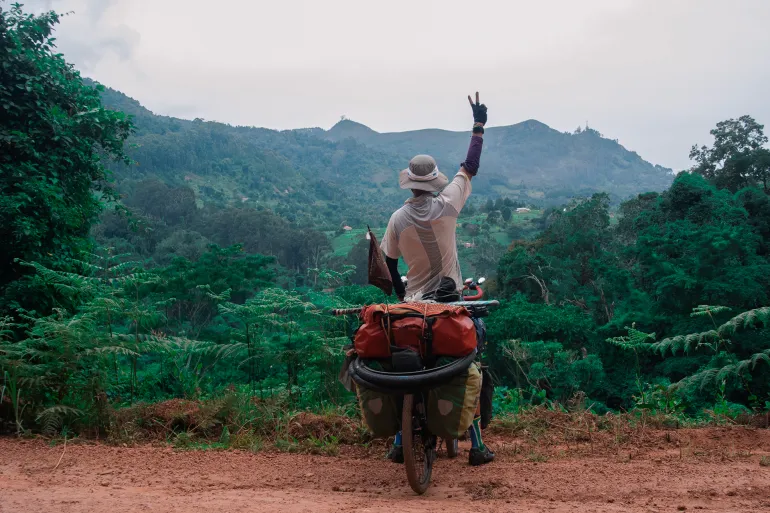
Abdelhadi turned his dream of watching National Geographic documentaries into reality starting in 2018, and the most difficult moments that shaped him were on the road from Morocco to Cape Lagolas (the southernmost point of Africa) over 18 months.
Abdul Hadi, who has visited 43 countries so far, recalls the difficult continuation of his journey in his interview with Al Jazeera Net, saying, “In Botswana, I was attacked and my bicycle was vandalized, and I had to undergo surgery.
What happened to this Moroccan traveler coincided with the spread of the Coronavirus, so Abdelhadi remained stranded for a year and three months. He says, “I felt like a caged bird, and in Niger the army detained me for 20 full days in an investigation center before the Moroccan embassy intervened to release me.”
Human encounter
For these adventurers, travel is not just about searching for tourist spots, but about finding the truth among the people in those places.
Youssef Sahsah speaks about his personal transformation, saying, “I consider Africans to be my brothers. They helped me on my journey, and I cannot deny this. They taught me about giving, love, and sharing, and I believe that life is lived through sharing.”
Maryam shares this deep sense of human connection even after fatigue and hardship, as she describes the encounters with the people of African countries, saying, “The relationship with the communities I passed through was one of the most beautiful aspects of the journey. People often welcomed me warmly, helped me, or gave me water and food.
The Moroccan traveler adds that this interaction made her feel that the trip was not just about riding a bicycle, but a real human encounter, and she says, “This affected me a lot because it made me believe more in the value of human communication.”
African spirit
Even after a serious car accident in Ivory Coast, Mohamed Saleki found support in the African spirit that loves life.
Saleki recalls the incident with gratitude: “I was hit by a small car in Ivory Coast, and the trip was halted for 4 months. I attended the Africa Cup of Nations matches despite the difficulty, but the atmosphere was very beautiful, especially with the Ivorian people who love football.
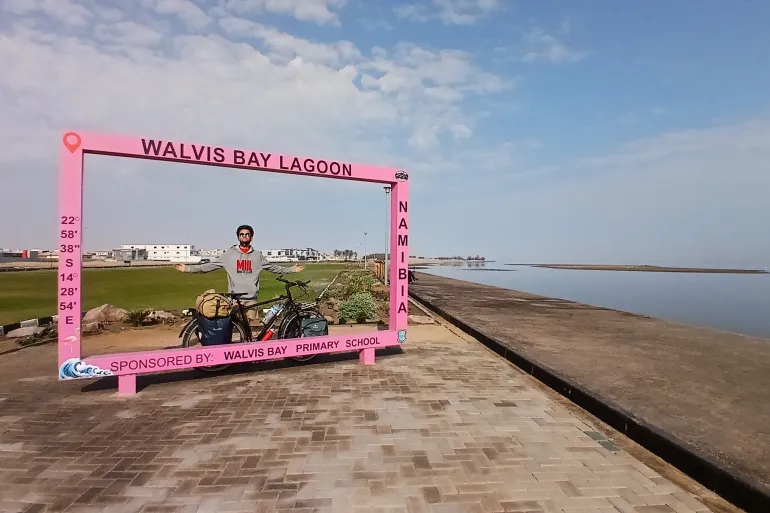
While in Namibia, which he considers his favorite country, Abdul Hadi finds a lesson that is both harsh and beautiful, when he contracts malaria and a Muslim doctor from Congo takes care of his treatment.
Abdul Hadi concludes his journey of self-improvement by saying, “Despite all these obstacles, I believe that every difficult situation held something beautiful within it, taught me a lesson, and increased my strength and determination. This journey is not just about moving between countries, but a complete life experience that has remade me.