The summer nap was going as it should: sleepiness, air conditioner playing winter tunes in the height of summer, and a dark curtain tightly closed, until the phone vibrated with the sound of a WhatsApp notification. It’s Indonesian Mubin, a friend from university, crammed into a four-hour transit at Doha airport.
He asked if these hours were enough to leave the airport and visit Doha, and I replied that they were enough to make love with a city designed to be loved.
Minutes later, I was at the airport. I asked Mubeen from which Indonesia we were coming from, and he said that he was from Bali, and here my enthusiasm for the tour increased, as Indonesia is on the map of my tourist dreams. I hoped to myself that whoever offers Doha to you today might offer you Bali tomorrow, but it is an answer filled with a lot of challenge: whoever sleeps to the music of waves and waterfalls, and wakes up to forests and rice terraces, will not be easily amazed by cities. But who knows? This is Doha! A city that knows how to surprise the visitor and then retain a share of his nostalgia.
There is another reason for optimism. Fortunately for Doha, those who visit it begin with an underlying passion, and all you have to do is move its components to arouse its motivation.
Mubin did not let me down. He told me about his views during the World Cup of footage from the Qatari capital, preserved in his imagination for a day like this.
I just told him, “Get in, and I will take you to a place you won’t forget.” I did not tell him where, and I let the enthusiasm quietly cook on the fire of curiosity.
Doha Corniche
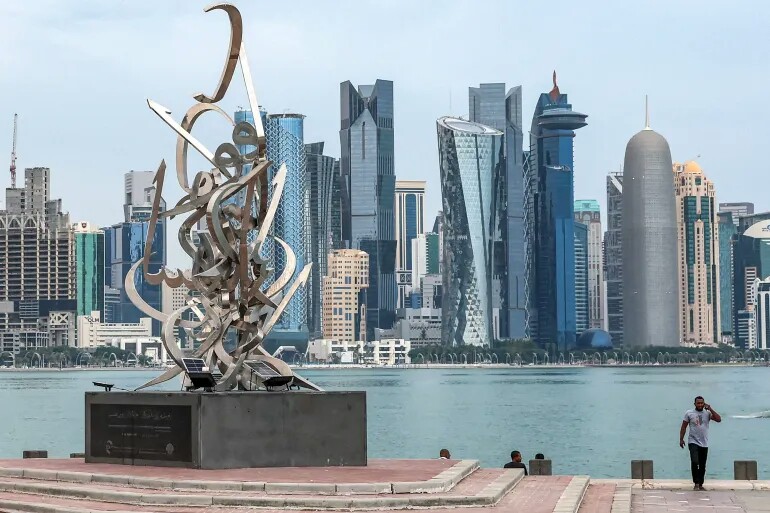
The first stop is the Doha Corniche, the city’s postcard, and the place takes you through its summary faster than any guide. From here you can see everything at once.
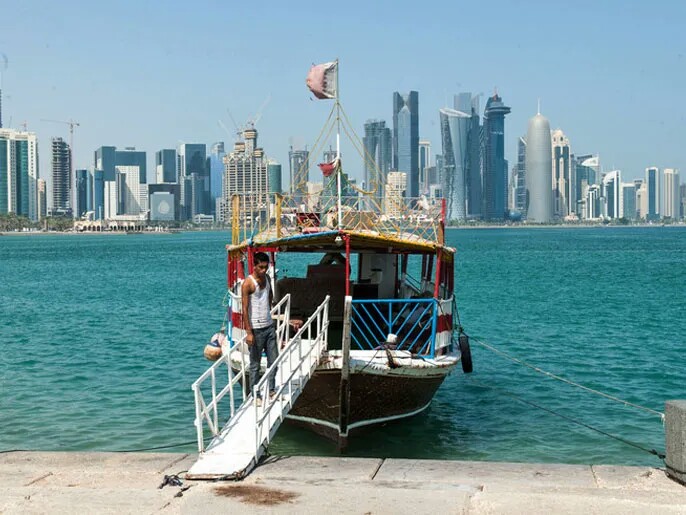
It is the witness to the story of the city’s rapid growth, and its towers stand in front of it with all dignity, waving to you that they are waiting for you… But before all that, the old port of Doha, which breathes modernity on the other side of the beach.
On a third party, you will not miss Stadium 974, one of the imprints of the Qatar World Cup, which carried its message to the world in the colors of shipping containers.
The message is a flexible playground that can be moved in whole or in part and its components shared, rather than leaving them wasted, and it summarizes the vocabulary of adaptability, openness, communication, simplicity, and rejection of grandiose embellishment. Above all, he tells you, “We are trying new practical ideas.”
The first signs of anxiety appeared on Mubin’s face as he inquired whether four hours were enough to reach the outskirts of the city, with this extensive explanation of the meanings and connotations of the places. I said with a smile, “The advantage of Doha is that it is small enough to see it all, and large enough to amaze you.”
The Corniche here is not just a walkway on the sea, but rather the country’s people’s gateway to the ancient world, the source of their air and their comfort when they were tired, and their morning on their vacation, where their ancestors earned their livelihood, and the sea sang pearl songs to them before the city bought its jewelry from the malls.
It is the meeting place for their joys and national days, their refuge from the summer heat, and their meeting place on winter evenings.
Souq Waqif
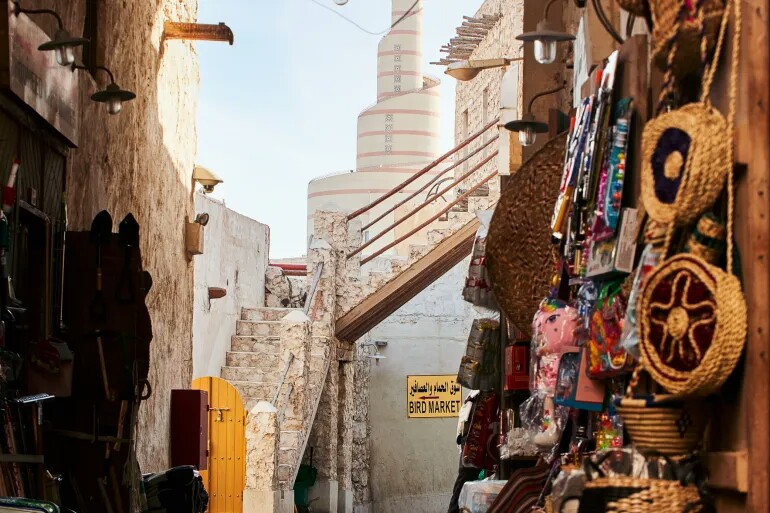
The smell of cumin and cardamom interrupted us, announcing that we were in front of Souq Waqif, where the five senses communicated in a state of emergency meeting, the colors of embroidered fabrics, the voices of vendors with Arabic-Indian accents. “It was as if we were in front of a National Geographic screen,” Mubeen said, so I said, “Perhaps, especially if the background was the minaret of the Fanar Mosque, which introduces Islam to visitors to the city, as if saying, ‘Look at me, I am an integral part of the story.’”
Nearby is the Museum of Islamic Art, in the heart of the sea. Here the sand reconciles with the water, and the towers raise their necks in greeting from its wide windows. A natural painting that complements for you the paintings of history that you passed through the museum’s walls and then whispers in your ear, “The art here is not only hung on the walls… but rather it appears from the generous windows.”
Musheireb neighborhood
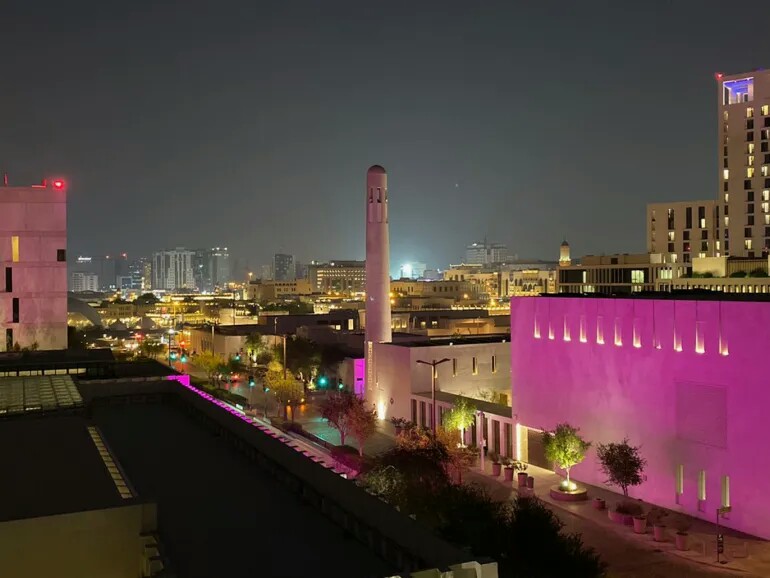
Nearby, we were on a date with Msheireb, a smart neighborhood engraved in the memory of the first people of Doha. In its depth, we stopped at Bin Jelmoud House, a museum that displays the slave trade and slavery in the Gulf, with all its painful details: statues, documents, pictures, and voices telling stories that were not told.
It is the Qatari way of confronting a page of history that some people prefer to hide under decorated oriental carpets.
Next to it, the Company House Museum presents not only the story of oil, but also the story of people who lived in its shadow, worked under its sun, and participated in building modern Qatar. It is a reminder that wealth begins not only with the well, but with the man who dug it.
Musheireb promises you a lot, but the hills of the cultural district in Katara were calling to us from afar along with the Corniche Road and the sea, which apparently stirred up a clear longing for his city. “Qatar is like a five-star resort, very organized. Bali is like my grandmother’s house, chaotic, but it has the smell of family gathering.”
The family gathering in Qatar is in Souq Waqif, every corner tells an old story, every corner bends in the bends of the alleys, spontaneous, narrow, but honest, and the sea watches it silently. Even if you don’t buy anything from him, you will walk out with a smile and lots of pictures.
In Souq Waqif, Doha lives and learns about its history, and as for our next destination, Qatar shakes hands with the world.
Katara neighborhood
This is Katara, where heritage is not only alive, but displays its preciousness, boasts and announces its openness to the world with all its vast spaces.
In Katara, the world meets in one street. Here the Turkish restaurant flirts with the smell of the Palestinian falafel kebab, the Lebanese at the top of the hill sprinkles it with thyme, and the Indian smiles with spices. Shakespeare sleeps on the marble of the open theatre, his eyes on the sea, and his nose fragrant with saffron, majbous, and khanfroush.
Mubeen laughs and says: In Bali, nature amazes you… Here, all cultures fight over who will amaze you first!
Suddenly, the wind of youth blew on my friend, refreshing his sweaty face, and his features and features seemed to change. What do you notice? I asked him and he said: The weather here has suddenly moved from summer to spring, so I said it is the astonishment of spring coming from the ground through innovative air conditioning tubes, in this unique street of its kind with outdoor air conditioning that guarantees its visitor in the height of summer minutes of spring breezes.
Pearl Island
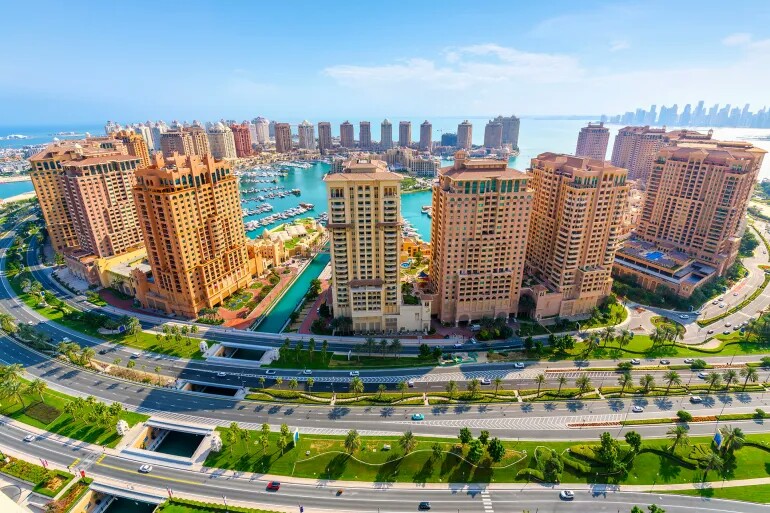
Not long ago, we were on an encounter with the Pearl, an artificial island. At its gates, the sea took off its traditional bisht and put on its official suit. The buildings sparkle like a veritable array of pearls, and the yachts are lined up with surprising regularity.
At the end of the walkway, the surprise I left for my guest was the architectural masterpiece that overlooked the place with regal grace, as if a piece of Istanbul had quietly slipped out of the history book and settled in Qatar to captivate hearts.
Hamad Bin Jassim Mosque, and if you think that all mosques are similar, you have not yet seen this mosque, where soft alabaster meets luxurious marble, and golden decorations and hand-engraved engravings dance on the walls, then suddenly deliver you to carefully distributed windows to present you with a copy of the beauty of nature and the luxurious homes that surround the place.
Every corner tells you, “Here beauty is not made, but woven with perfection.”
I saw Mubin pick up his phone for the first time on the tour, photographing the walls, decorations, and paintings, as if he was afraid to miss a scene from paradise, when the beauty of sober decoration meets the beauty of nature coming through the generous windows of life.
Lusail City
In neighboring Lusail lies the newest of the Doha sisters, the best designed and organized. We sat on its beach drinking karak tea, while I watched him as he did not stop photographing. I told him lightly, “Four hours, and I fell in love.”
We were racing against Morocco when, on our return trip, we passed in front of the Qatar National Museum with its strange design inspired by a desert flower, calling you on the return trip towards the airport. Remember that here is a city that knows that beauty can be born from sand, and that the desert is not a vacuum but a space for creativity.
A city small in size, big in experience. It dazzles you in a few hours, and leaves you in a long state of nostalgia.