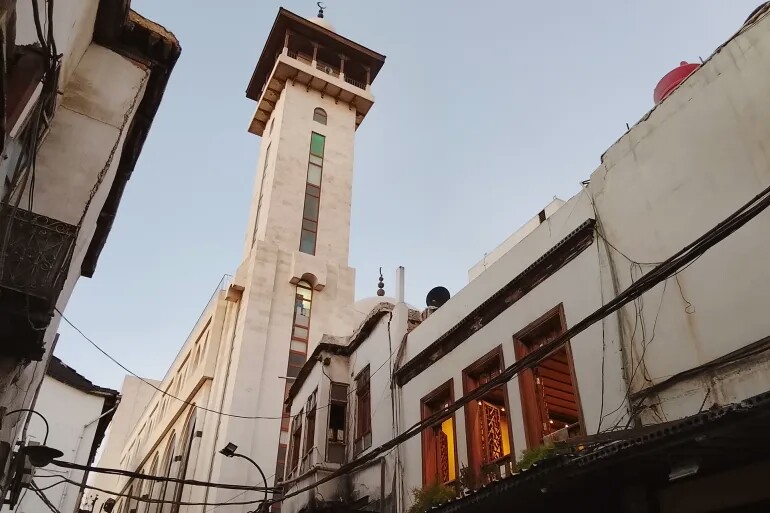
In the south-eastern side of Old Damascus, where the fragrance of history meets the breath of the present, Al-Amin neighborhood extends as if it were a hymn of loyalty echoing in the ear of time, a poem of stillness overflowing with life, its verses harmonizing with the purring of the alleys and the voices of passers-by, and its rhymes preserve the memory of the city that was born from the womb of the soul.
The neighborhood wakes up at dawn to the whisper of the minarets, and the wooden windows cast their shadows on the roads, welcoming passers-by, carrying ancient stories stored in the ancient walls.
In its alleys, stories are intertwined: scholars who taught wisdom, merchants who opened their small shops, women who wove cloaks that smelled of musk, and children who filled the place with laughter as if it were a hymn to an unquenchable life.
The smells of spices and Damascene roses intersect in its atmosphere with the voices of the vendors and their ancient dialects, transforming the neighborhood into a melody of authenticity and tranquility that sings with a never-aging memory.
A name that exudes serenity and tranquility
It is said that the name of the Al-Amin neighborhood was based around a shrine for Al-Sayyid Al-Amin, attributed to one of the nobles of the family of the Prophet. It was embraced by a warm neighborhood with a green dome in the middle and a small square shaded by a mulberry tree, in which gatherings of remembrance were held, signs of good deeds were recited, and vows were distributed. The name became a blessing that spread throughout the neighborhood like an ancient perfume.
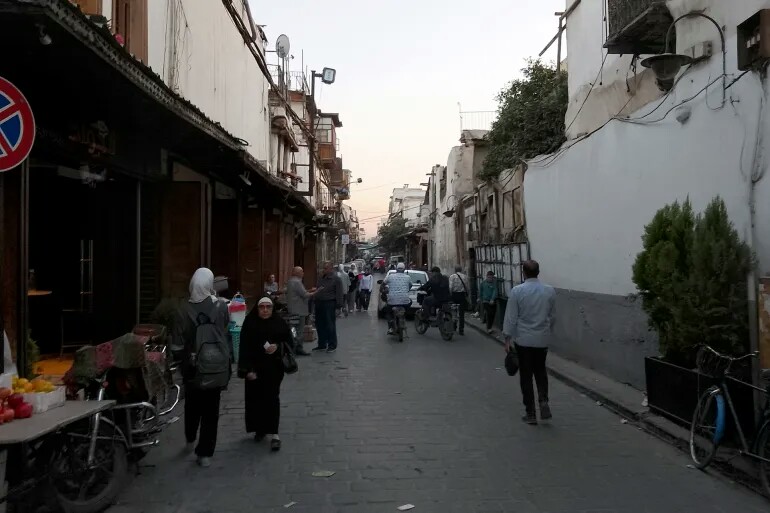
The name has two intertwined meanings: the trustworthiness with which the Prophet, may God bless him and grant him peace, was described, and the security that the resident and passer-by can be reassured by. The neighborhood became a mirror of the values of loyalty and honesty, in which sales were concluded with a handshake, and deposits were received with an eye gesture and a smile of satisfaction, until the merchants took the names of their shops from the same root: Amin, Aman, and Trustworthy, as if the name was a moral charter regulating the life of the market and the neighborhood.
Branching off from Al-Amin Street are alleys that lead to chapels, marble waterways decorated with carvings, and markets fragrant with the scent of sweets and roses. During the seasons, chanting and praise gatherings are held, and balconies are lit with lanterns, turning the alleys into pearls of light.
The effect of the name is evident in the social fabric: reconciliation councils, science lessons after sunset, women memorizing recipes and vows, children learning the first letters under the shade of the courtyards, dawn recitations being louder and shops opening to the sound of the jingling of keys, as if the day began with the name and then branched out into work and worship.
The meaning is also reflected in the architecture: secure wooden doors, shiny copper latches, ample mashrabiya windows, and fountains that honor the water, all of which are evidence of the integrity of the craftsmanship and the precision of the hand.
Thus, “Al-Amin” was transformed from a title on a position into a covenant for living, in which the word was preserved and the market was managed with the wisdom of a sheikh who sat as a balance of justice and love. The name became a tone in the conscience of Damascus, reminding it that authenticity is a spirit that preserves cities, and that honest names give the place the reassurance of survival.
On the borders of the heart and the entrances to light
Al-Amin neighborhood is located in the heart of Old Damascus, like a jewel tied to a necklace of ancient neighborhoods. The vacancy is adjacent and in contact with architecture, and extends with its pulse towards the axis of the historical markets, where crafts, goods, and faces coexist. From its eastern side, there are corridors leading to the paths of Bab Sharqi and Bab Kisan, and from its inner side, gentle paths branch out that take the passer-by back to the heart of the Levantine house, as if the neighborhood is a heart distributing blood to the outskirts of the city and calling it to a single center.
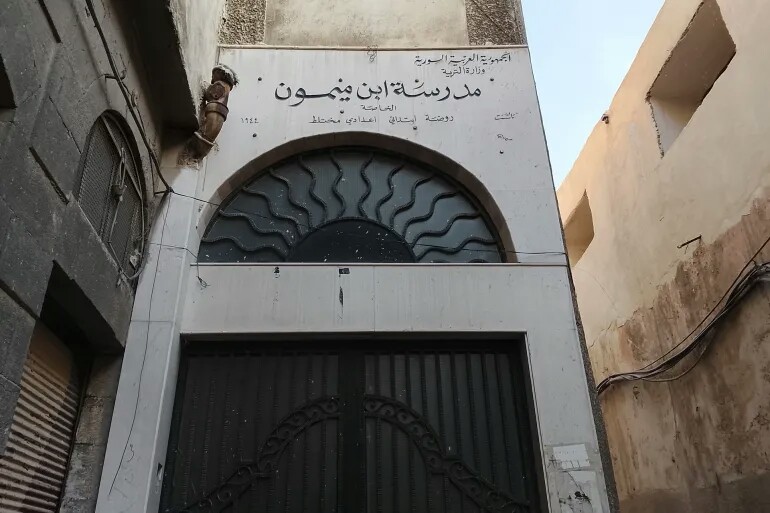
Al-Amin Street forms the most prominent artery that flows longitudinally and then branches into alleys that elegantly intertwine with the architecture. Narrow alleys tempt one to slow down and encourage listening, and at their intersections small urban nodes are formed. A space in front of a marble water fountain, a sidewalk overlooking an antique sweet shop, and the threshold of a mosque that accommodates reassuring steps. The width of the corridors changes according to the movement of the sun and wind. Some of them receive the morning sun and become a corridor of warmth, while some of them are shaded by the wing of an old house, turning into a cool hallway that prepares the heart for the sound of the call to prayer.
The daylights creep in from the high openings and the colored wooden balconies, casting bright shadows on the stone like a living mosaic, and the corners are topped with small domes that color the sky, and are shaded by delicate mashrabiyas that soften the glare of the sun and infuse the place with modesty and calm. At noon, the breeze flows through the corridors like a musical string, knocking on the doors and concluding an agreement between the climate and the architecture for permanent tranquility.
When the neighborhood comes into contact with the major markets, its social face becomes clear: lanes supplying bread and vegetables, small carts moving lightly, the voices of vendors intermingling with the calls of children emerging from the kataeb, and herbalist and spice shops and craft and embroidered textile workshops distributed on both sides of the road.
Fajr recitations rise from the mosques, and the sunset lessons conclude with notes of serenity, so the neighborhood becomes a system of light, sustenance, and remembrance that extends from sunrise to sunset.
The spatial scene progresses from the arterial street to a small knot, then to a cozy alley that ends with a tight wooden door that leads to a courtyard in which a graceful fountain whispers. Thus, layers of belonging are formed: a connection to the market that regulates livelihood, to the alley that refines the neighborhood, and to the courtyard where the soul resides.
The neighborhood retains quasi-monastic pockets deep within its fabric. Short stairs lead to small shrines and terraces containing a circle of knowledge or chanting councils, and the doors of floors hide from passersby with an oriental modesty, as if the place was balancing between openness to movement and keeping the secrets of the house. From a limited height on the ground line, some alleys lean gently towards the south, creating a visual stream that catches the eye of the passer-by and leads him to a dome or minaret that determines the direction and confirms the connection of the place to prayer and time.
With these elements combined, Al-Amin neighborhood becomes a precise point of balance: a deliberate proximity to the commercial arteries and a calculated distance to the historical gates, a network of alleys that formulate the morals of housing and entrances of light that teach stone the blessing of moderation. A site close to the heart, writing on the maps of Damascus a lesson in emotional geometry, where geography is equated with memory and life is managed according to a compass that points to the market during the day and to the prayer mihrab in the evening.
Between originality and transformations
Al-Amin neighborhood is in the midst of an era that is reshaping the Damascene landscape, stone by stone. The daily rhythm begins at dawn. Melodious recitations from the nearby mosques, keys turning the locks in the apothecary, candy and textile shops, carts of vegetables brought from the city’s environs, and families preparing for the neighborhood’s schools and workshops. At noon, the market reaches its peak around Al-Amin Street, an urban farm of wooden facades, shutters embroidered with copper, and the voices of vendors memorizing dictionaries of spices and weights. With sunset, the noise decreases, the lamps of small cafés are lit, and male gatherings are held in the corners. Short jurisprudence lessons on the custom of the place.
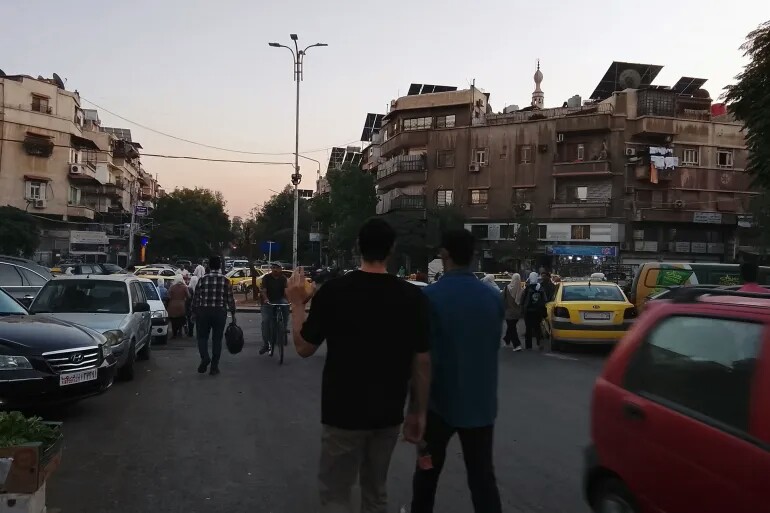
In the social fabric, old Damascene families coexist with families who have migrated to the neighborhood in recent decades, creating a network of relationships managed by custom. As for urban services, they have undergone layers of modernization: water and electricity networks have been rehabilitated, drainage extensions that need improvement in some narrow alleys, waste collection points that require redistribution in line with the movement of pedestrians, manual wheel lanes, and daily movement depends on walking, bicycles, and small carts, while cars settle on the margins of the neighborhood near the major axes, which saves the alleys from suffocating congestion and keeps the scene livable.
The neighborhood’s economy consists of three overlapping layers: daily trade for residents of the interior (baker, blacksmith, tailor, perfumer), local services directed to visitors to the nearby historical markets (sweets, Damascus-themed souvenirs, home kitchens), and small investments in homes that have been turned into family guest houses or art studios. Religious seasons give the economic cycle a tangible boost, such as the nights of Ramadan, the recitations of the Prophet’s birthday, and the chanting sessions that revive sales of sweets and perfumes and restore vitality to the alleys.
Residential transformations show a complex mix: old families who maintained their role through ownership inheritance, young families who rented heritage houses and began gradual restoration, and shared ownership among many heirs that delay the decision on maintenance, thus forming a delicate urban complex here, and the fragmentation of properties slows down restoration, in addition to the high cost of traditional materials that puts pressure on budgets, while the local economy offers innovative solutions such as participation in restoration in exchange for partial use of the courtyard or roof.
The cultural scene maintains a clear religious and spiritual spirit, with mosques, small Sharia schools, corners that hold hearing sessions on specific evenings, reading initiatives for young people in the courtyards of homes, and mini-exhibitions of woodwork and embroidery. All of this is combined with a close memory that is repeated in grandmothers’ stories about merchants, scholars, and visitors, so the oral narrative turns into an identity pillar through which the character of the new generation is formulated.
Looming on the outskirts are modern buildings that add vertical density and pose subtle questions about visual balance and the horizon line; Here, maintenance and restoration companies are submitting plans that take into account historical building materials, while residents are presenting contemporary needs related to thermal insulation, hall ventilation, humidity management, and smaller energy solutions for narrow alleys. It also offers smart lighting solutions that maintain a pleasant darkness at night without losing safety, so the glass lanterns remain part of the scene while being supported by hidden technologies.
Real estate prices have witnessed successive waves. The demand for restored heritage houses is on the rise, rents tend to stabilize in the inner alleys and increase relatively near the commercial arteries, modern deals tend to combine housing and work within one house, and the partial conversion of floors into family hospitality units creates additional income and stimulates daily care of the place.
The biggest challenge revolves around managing the transformation, as what is required is to establish precise standards for interventions, such as maintaining the ablaq stone without obliterating the traces of time, restoring the mashrabiyas with privacy-preserving glass solutions, restoring the fountains as a functional component of beauty and ventilation, and reviving the old watering holes as elements of visual education for the children of the neighborhood. These details are integrated with Subya programs to learn fine crafts, family documentation sessions for pictures of the role and its biography, and initiatives by women who memorize recipes for sweets and perfumes as symbolic and economic capital.
The honest neighborhood awaits a future that does justice to it, balances urban and humanitarian needs, and restores the Damascene house its position as a haven of tranquility, the neighborhood has its function of being a small, cohesive community, and the mosque has its role in developing the spirit and mind together.
Al-Amin is not a living person made of clay and stone, but rather a spirit inhabited by the city to remember itself whenever it is about to forget, and his next battle is not with time but with forgetfulness, to prove that the memory that is narrated by faith does not know fading.